





Ranking Man Utd’s 25 Premier League goalkeepers from worst to best
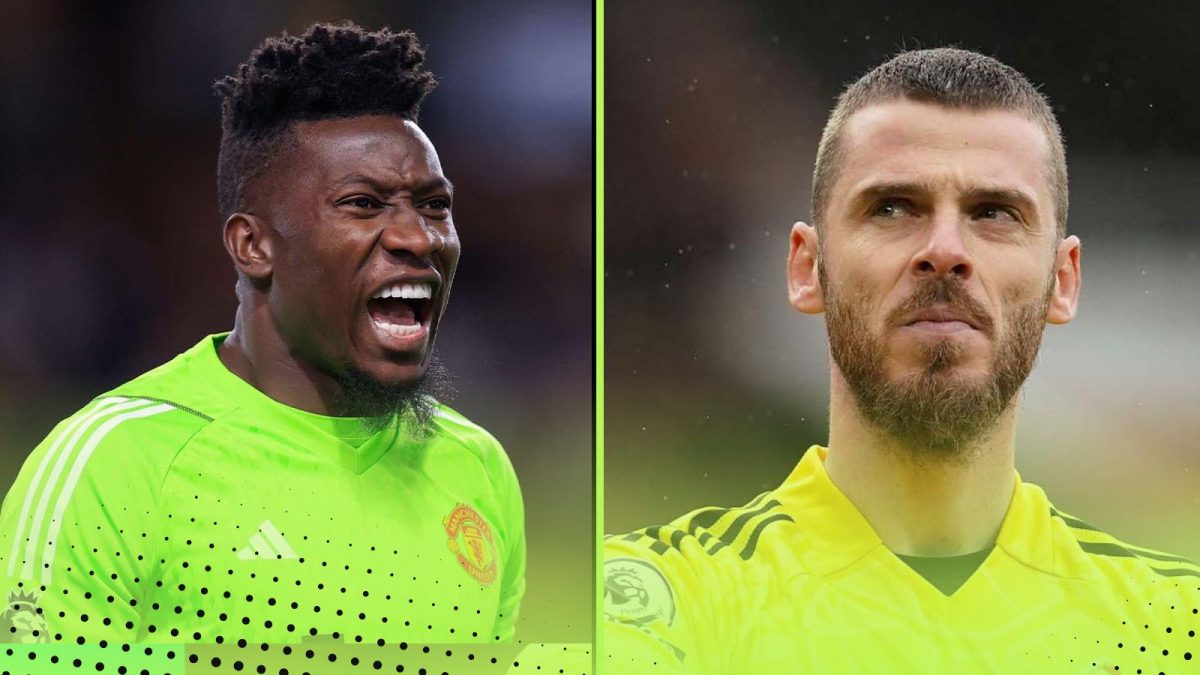
Manchester United have had some excellent goalkeepers down the years, but it’s certainly not always been that way for them during the Premier League era.
Beyond the reliability of Peter Schmeichel, Edwin Van der Sar and David de Gea, United have not always had a safe pair of hands between the sticks, while they’ve had several second and third-choice options don the gloves over the years.
So we’ve ranked all 25 goalkeepers to make a Premier League appearance for the club, based on how they performed at Old Trafford. No points for guessing who’s bottom…
25. Massimo Taibi
A name synonymous with comedy goalkeeping, the Italian was first called into action in the 1999-2000 season when both Mark Bosnich and Raimond van der Gouw were injured.
He flapped at a free-kick to concede in his league debut against Liverpool but recovered to make a number of important saves in a 3-2 win and was named man of the match.
However, he would permanently leave his reputation in tatters when he allowed a weak Matt Le Tissier shot to roll through his legs in a 3-3 draw against Southampton, arguably the most notorious howler in Premier League history.
He then conceded five against Chelsea in his fourth and final league appearance, Manchester United’s first league defeat in almost a year.
24. Andre Onana
Nemanja Matic’s described the Cameroonian as United’s ‘worst ever goalkeeper’ and while, technically, that might not be true, he’s certainly the most disappointing.
Onana was such a let-down. Taking over from a past-his-best David De Gea, the ex-Inter and Ajax keeper was supposed to provide a safer pair of hands while also improving United in possession.
He did neither. He was so error prone that it is hard to see who he was ever scouted and analysed without his flaws being identified.
That’s on all of us. None of us called out Onana’s signing as the shocker it was to become.
But it says so much that when United came to move him on, there were virtually no takers aside from Trabzonspor. And just the display of some basic competency from his replacement made Senne Lammens looks like Lev Yashin in comparison.
23. Mark Bosnich
Manchester United first signed the Australian at the end of the 1980s but had to let him go due to visa issues as Schmeichel was brought in.
Bosnich spent seven years at Aston Villa, establishing himself as a steady pair of hands, and was brought back to replace Schmeichel in 1999, though Ferguson tried to halt the deal, but only after chairman Martin Edwards had shook on it.
He won the title as the No.1 in 1999-00 but more in spite of Bosnich than because of him. Ferguson later called him “a terrible professional” and many ex-team-mates agree.
22. Nick Culkin
Culkin holds the record for the shortest debut in Premier League history, replacing Van der Gouw in stoppage time at Highbury in 1999. It was his only league appearance, which amounted to one free-kick.
He achieved little of note in the rest of his career but become the first player to play for both Manchester United and FC United of Manchester when he joined the non-league outfit in 2014.

READ: The story of Nick Culkin at Man Utd and the shortest-ever Prem career
21. Paul Rachubka
Rachubka made one league appearance as a teenager, being called into action against Leicester when Fabien Barthez was injured in the warm-up. Kept a clean sheet.
He went on to become a Football League stalwart and infamous figure at Leeds United after a horror show of a performance against Blackpool in 2011, which saw him subbed off at half-time after making three errors that led to goals, plus one of his team-mates being sent off.
20. Victor Valdes
The Barcelona legend made just two league appearances after United helped to rehabilitate him following an anterior cruciate ligament injury that brought a sad end to his time at the Catalan club.
Personal problems with Louis Van Gaal marked a sad end to a glittering career.
Released by the club in 2016, his last season in football ended in relegation with Middlesbrough.
19. Joel Pereira
The Portuguese is currently on his sixth loan spell away from the Red Devils following the return of Dean Henderson.
Plenty was expected of Pereira but a run-out in an end-of-season dead rubber at home against Crystal Palace in May 2017 was his only Premier League appearance amid a flurry of loan spells away from Old Trafford.
After eventually leaving United permanently, Pereira had an underwhelming spell in Netherlands with RKC Waalwijk before returning to England to find his level in League One with Reading.
18. Ben Amos
Sir Alex Ferguson occasionally called on the academy product for cup games, but Amos made just one appearance in the league, keeping a clean sheet in a 2-0 win over Stoke in 2012.
After flitting around the EFL, Amos secured the cushy third-choice-keeper gig at Burnley.
17. Ricardo
The Spanish international made one league appearance when he came on for an injured Fabien Barthez against Blackburn in 2003. His first action was to give away a penalty, which he then saved as David Dunn struck to his left. Show off.

READ: The story of Ricardo’s three years at Man Utd and how it shaped his career
16. Andy Goram
Rangers legend Goram was signed as an emergency measure in 2001 when Barthez and Van der Gouw were out injured. Then 36 years old, he’d already made over 500 appearances for Gers, Oldham, Hibernian.
He started against Coventry and Southampton as United closed in on the 2001 league title, conceding two goals in each game.
The former Scotland international, one of his nation’s best-ever goalkeepers, sadly passed away in July 2022 at the age of 58.
15. Kevin Pilkington
A loyal servant for six years as a youngster, Pilkington featured in the FA Youth Cup triumph of 1992 alongside some more illustrious names.
He was United’s third-choice goalkeeper in the Peter Schmeichel era and made just six league appearances between 1992 and 1998.
Pilkington later made over 300 combined appearances for Mansfield Town and Notts County.
14. Dean Henderson
After impressing on loan at Sheffield United, Henderson decided to return to United and challenge David de Gea for the No.1 jersey in 2020-21.
The England international briefly managed to usurp De Gea during the latter half of the campaign, but dropped back down the pecking order behind the Spaniard in 2021-22.
When the battle was lost, Henderson secured a loan move to Nottingham Forest before moving on to Crystal Palace, where he became on the Premier League’s best stoppers and England no.2.
13. Anders Lindegaard
Lindegaard was considered a potential future No.1 when he was bought in 2010 as United looked to a future without the ageing Edwin van der Sar.
While there were some positive signs, it became clear that he was not capable of being a successor and would have to settle for a role as back-up. He made 19 league appearances in five seasons at the club, 10 of which came in the title-winning campaign of 2012-13.
READ MORE: An XI of transfer targets Man Utd dodged a bullet with: Diouf, Hirst…
TRY A QUIZ: Can you name every £10m+ player Sir Alex Ferguson signed for Man Utd?
12. Tomasz Kuszczak
Making 26 appearances in six years at the club, Kuszczak’s time at Old Trafford coincided with great success as he deputised for Edwin van der Sar.
The Pole clearly wasn’t good enough to be first choice, however, and United often suffered from a lack of understanding between him and the back four, notably as he dawdled to allow Jermaine Beckford to score past him in Leeds United’s FA Cup win in 2010.
He was trusted between the posts for their League Cup win that season, though.
11. Ben Foster
Signed in 2005 but loaned out to Watford for two years, Foster was eventually given some limited opportunities by United after helping the Hornets to promotion in 2006 and looking solid in the Premier League the following year.
Foster established himself as a steady Premier League presence elsewhere but made just 12 league appearances in three years at Old Trafford. He did play a role in the 2009 League Cup win, though.
10. Gary Walsh
A loyal club servant, most of his 50 appearances for the club came before the Premier League era as United struggled to reassert their dominance.
Walsh would likely have been number one for a long stretch were it not for a head injury sustained in a mid-season friendly in Bermuda in 1987 and a succession of subsequent injuries.
He made 10 appearances in the 1994-95 season when Schmeichel was injured, the only title in the first five years of the Premier League that United failed to win.
9. Sergio Romero
Somehow a career stand-in at club level but Argentina no.1, Romero joined United in 2015 and spent six years at the club as a back up following stints on the bench at Sampdoria and Monaco
He made just seven Premier League appearances for the Red Devils but featured throughout the Europa League-winning campaign of 2016-17.
8. Roy Carroll
The Northern Ireland international will always be remembered for his blunder against Tottenham when he flapped at Pedro Mendes’ cross and allowed the ball to cross over the line.
Fortunately the referee let him off, but had it been correctly allowed it would have gone down in history, filed next to Taibi’s howler.
Overall, though, he had a good record. Lapses aside, he kept a clean sheet in half of his 46 league appearances.
Happy 41st Birthday Pedro Mendes.
And Roy Carroll better send you a fucking decent card.pic.twitter.com/gRtxpLeh4X
— A Funny Old Game (@sid_lambert) February 26, 2020
7. Tim Howard
The American showed how reliable and comfortable he was with Premier League football as he made over 350 league appearances spanning a decade at Everton.
At United, his courage and personality had some considering him Peter Schmeichel’s true successor, but it wasn’t to be. And his time in Manchester coincided with a fallow period for the club – they fell 15 points behind Arsenal’s Invincibles in his only full season and then fell short of Jose Mourinho’s Chelsea.
6. Raimond van der Gouw
Arriving in 1996 from Vitesse Arnhem, the 6’3” Dutchman has a case of being Manchester United’s best back-up of the Premier League era, proving reliable whenever Schmeichel was sidelined.
He eventually got more opportunities after the Dane left in 1999, competing with Bosnich for the starting position. He made 14 appearances in the 1999-2000 season and 10 in 2000-01 as the club won back-to-back league titles.
5. Senne Lammens
Lammens only had to show a grasp of the goalkeeping fundamentals to be an upgrade on Onana, and the Belgium’s calmness was blissful compared to the chaos around his predecessor.
Of course, Lammens deserves more credit than just being better than the third-worst United keeper. He has made big saves behind a defence that remains the Red Devils’ weakness.
At Old Trafford, any goalkeeper is only three bad games from being branded a calamity, but Lammens has shown impressive consistency, especially for a stopper still so young.
4. Fabien Barthez
The World Cup winner with France was seen as the man to fill Schmeichel’s shoes and for a season, it looked as United had cracked it.
But Barthez could not provide long-term security in United’s goal. His style makes him prone to errors and too many eventually saw Ferguson shift him out.
For a while, though, he was great fun to watch and two league titles in three full years as No.1 is a decent enough return.
3. David de Gea
In terms of individual brilliance, De Gea was, for a time, arguably the best. But he’s a victim of circumstance which means he can’t rank any higher on this list.
The Spaniard put a dreadful start behind him to excel in the 2013 title win, Ferguson’s last. And he eventually completed a set of domestic trophies with an FA Cup under Louis van Gaal and League Cup under Jose Mourinho.
His best form made him one of the very best in the world, and he would have joined Real Madrid in 2015 if someone in the process of rubberstamping the deal didn’t screw up.
But De Gea seemed to stagnate. Actually, he regressed. In possession, one of the strengths that United identified when they signed a waifish kid, became his weakness. You could say the same about his shotstopping prowess. In his last seasons at United, too often he was too easily beaten.
Still, being a four-time Player of the Year means he is remembered more fondly for his peak period than his later flaws.
2. Edwin van der Sar
A career bookended with wonderful highs after he established himself as a sweeper for Louis Van Gaal’s all-conquering Ajax in the early 90s.
At 42.17%, he actually has the best games to clean sheets ratio of any Manchester United goalkeeper to make over 50 Premier League appearances, and third overall behind Petr Cech and Pepe Reina.
Considering that ratio includes four mid-table seasons at Fulham, it underlines how imperious United were at the back in his years there.
A key part of arguably the club’s best ever Premier League defensive unit, Van der Sar was as lucky to play behind peak Rio Ferdinand and Nemanja Vidic as they were to play ahead of him.
They won four league titles and reached three Champions League finals in his time at the club, winning the first thanks to Van der Sar’s penalty save from Nicolas Anelka.
Sadly he couldn’t bow out like Schmeichel with another one, as they were outclassed by Pep Guardiola’s Barcelona for a second time in 2011.
1. Peter Schmeichel
Alongside the captaincy of Roy Keane, the genius of Eric Cantona and the once-in-a-generation ‘Class Of 92’, Schmeichel was one of the defining names that re-established Manchester United as a genuine superclub.
After 26 years without a league title, Schmeichel was a key figure under Alex Ferguson as they ended that wait in 1993 and established their status as the biggest and most successful club of the Premier League era, setting the template for everything else that followed.
He won five league titles in eight years at the club and bowed out perfectly with his last appearance at the Camp Nou, lifting the Champions League trophy to complete their historic treble.
The Dane’s aggressive, front-foot style was perfect just as the backpass rule was introduced at the advent of the Premier League.

READ: A love letter to Peter Schmeichel’s long throws, a 90s superpower