





The making of O Fenomeno: How Ronaldo became a global superstar at PSV
How do you even begin to choose your favourite version of Ronaldo Nazario?
The prodigy at Cruzeiro? The unstoppable force of nature at Bobby Robson’s Barcelona? The Galactico at Real Madrid? The heartbreak of France 98, the glorious redemption of the 2002 World Cup or the pre-injury sensation at Inter, when he looked destined to become the greatest striker of all time?
He even had his moments in a brief, mostly forgettable stint at AC Milan before rounding out his career with yet more silverware at Corinthians.
Over time, Ronaldo’s physique famously changed dramatically, his game evolved and the freakish acceleration that once made him impossible to catch was compromised by injuries. He suffered serious knee injuries, underwent multiple operations and had to rebuild his career more than once.
Younger generations can spend hours watching Ronaldo highlights on YouTube and still miss something fundamental about his greatness. The goals, the skills and the trademark explosive bursts are all there, but clips can’t capture the resilience that became such a defining part of his legend.
Kylian Mbappe is the obvious modern reference point, stylistically speaking: no other player is blessed with that devastating combination of pace, dynamism and finishing.
But mercifully, the French superstar has been spared the harrowing injuries that repeatedly threatened Ronaldo’s career. Mbappe is yet to experience the extraordinary highs and lows, the adversity and the comebacks, that made Ronaldo’s story so compelling.
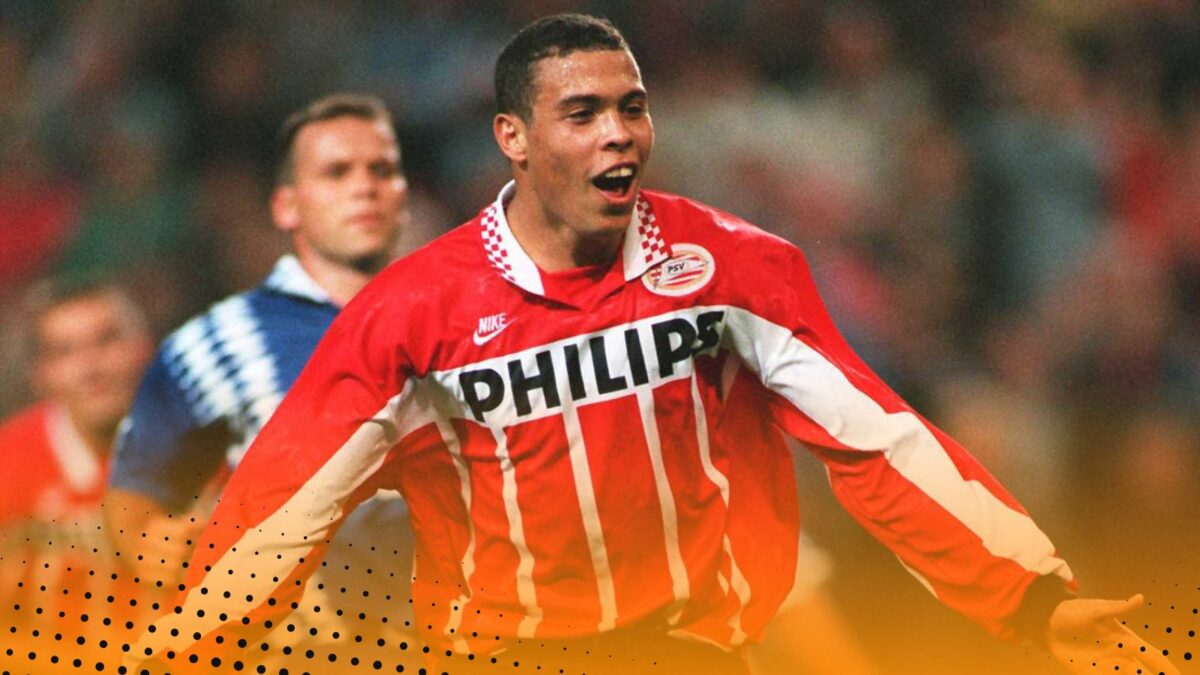
In many ways, you can trace the whole arc of Ronaldo’s career back to his two seasons with PSV.
The jaw-dropping athleticism, the insane rate of goalscoring, the sense that defenders were powerless to stop him – it was all there for a teenager in his first stint in Europe. So, too, was the first major injury setback, the beginning of a long and painful relationship with the treatment table.
Ronaldo arrived in Eindhoven in 1994 as a 17-year-old, fresh from being part of Brazil’s World Cup-winning squad, albeit without playing a minute.
It might seem an unlikely destination for South America’s hottest prospect, but the European football landscape was unrecognisable if you view it through a modern lens.
This was an era in which arguably the best forward in the world – Romario – had stayed in Eindhoven for five full seasons. Meanwhile, over in Amsterdam, Louis van Gaal was building the best team on the planet. Ajax won the Champions League in 1994-95; Ronaldo’s PSV were competing with one of the great teams of that era.
Ajax were the dominant force in Dutch football, built around an outstanding collective rather than one superstar. They had exceptional players, of course, but nobody quite like Ronaldo.
The teenager hit the ground running at PSV, scoring one and setting up another on his Eredivisie debut before proceeding to take the league by storm.
PSV were a different proposition altogether. They lacked their great rivals’ cohesion and tactical sophistication, and they made a chaotic start to that campaign.
A hat-trick from Ronaldo couldn’t prevent PSV from losing 5-4 to Bayer Leverkusen in an early-season UEFA Cup qualifier; an apt reflection of where that team was at.
“The Ronaldo show started, and he scored three goals,” former PSV Technical Director Frank Arnesen later told Mundial.
“But it wasn’t about the goals even; there was one detail in the game that was incredible. He received the ball in his own half. The ball is played to him, and the German right back assaults him from behind in a dangerous way.
“He lifts the ball with the outside of his left shoe, around the defender, and jumps. Ronaldo passes him by on the other side and starts a solo. He moves past three or four men, one man two times. Then all of Europe knew about Ronaldo.”
While Ronaldo was swiftly establishing himself as the most exciting talent of his generation, PSV were struggling to keep pace. Manager Aad de Mos had bafflingly deployed centre-forward Erik Meijer at left-back in the defeat to Leverkusen and departed in October.
Kees Rijvers stepped in on a caretaker basis before Dick Advocaat was eventually appointed in December, making for a turbulent introduction to life in Europe.
The Farmers – the club’s nickname, but not an entirely unfair reflection of their level – finished third, behind Roda JC and a full 14 points adrift of Van Gaal’s unbeaten Ajax side in 1994-95.
That gap would have been even greater under the three-points-for-a-win system. Still, in an otherwise struggling PSV side, Ronaldo was a class apart, claiming the Golden Boot with 30 Eredivisie goals – 12 more than his nearest challenger, fellow wonderkid Patrick Kluivert.
The buck-toothed teenager was doing that all that while adapting to life on a new continent, experiencing the culture shock of his first winter in the chilly, damp industrial heartland of the Netherlands.
It was there and then that he learned to drive, with his instructor recalling him in the glowing tones of a proud youth coach speaking to The Athletic for a long read.
“His driving skills were excellent, of course, but his scanning, his awareness of his surroundings, and his anticipation, the things we actually train for, were far from elite-level,” John Dekker told Dutch outlet omroepbrabant, with a nod to his student’s newfound celebrity status.
“It was incredible how quickly people recognised him. People crowding around the car, girls sitting on the hood… it was great fun.”
PSV were an entertaining side, but the real improvements came after a full pre-season under Advocaat. By the start of 1995-96, they looked a considerably more coherent outfit, with Ronaldo leading an increasingly formidable attack. They were routinely running riot domestically, putting four, five, seven and even eight goals past Eredivisie opponents.
@Inter_en @Ronaldo Sorry, but we’re not convinced 😜
Check these ⚽⚽⚽ out!
#PSVFCIM https://t.co/IVuyojH3Fe
— PSV (@PSV) October 2, 2018
O Fenomeno looked set to go truly stratospheric when he scored four goals and set up another two as PSV demolished Finnish minnows MyPa 7-1, a performance that bordered on bullying.
Yet the Dutch side had plenty of other weapons. Ronaldo sat out their 5-3 win over Leeds at Elland Road and wasn’t among the scorers in the 3-0 home victory in the second leg. There was no repeat of the previous season’s debacle as they cruised through qualifying into the UEFA Cup proper.
But just as things were gathering pace, Ronaldo suffered his first major injury: a patellar tendon tear that kept him sidelined for almost the entire second half of the season, including a minor UEFA Cup classic against Barcelona. PSV gave the Catalans two terrific games but ultimately bowed out 5-4 on aggregate in the quarter-finals.
Who knows what Advocaat’s PSV might have gone on to achieve had they kept their one bonafide superstar fit and available? They finished runners-up that season, closing the gap to just six points on an Ajax side that Van Gaal had led to a second successive Champions League final.
Ronaldo returned towards the end of the campaign, but not without conflict. His relaxed Brazilian temperament didn’t always sit comfortably with Advocaat’s strict Dutch sensibilities, echoing the coach’s issues with Gullit. Ronaldo reportedly called his manager an “idiot” after being left out of the starting XI for the KNVB Cup final.
“Yes, he did say that,” Advocaat later confirmed.
“Ronaldo was out injured for a long time in his second year. We used Rene Eijkelkamp in his place. When Ronaldo recovered, he demanded to start in the Cup final against Sparta. I didn’t want to take the risk, and he got very angry and said some harsh words. But we had no lasting problems.”
“At times, I felt like a father to him. After away games, he’d fall asleep on the bus with his head resting on my shoulder. He was open and had his personal struggles, but to me, he was a sweet kid.”
Ronaldo was introduced from the bench for a late cameo and promptly notched an assist, adding extra gloss to a 5-2 victory. He had his trophy, giving him a fitting send-off in his final appearance.
There would be considerably more spectacular comebacks in the years ahead. While the knee injury was an early warning of what was to come, it hadn’t yet taken anything away from Ronaldo’s extraordinary physical gifts.
At Barcelona the following season, he reached arguably the highest level of his career, described by Spanish football lifer Sid Lowe as “quite possibly the best, most freakishly brilliant thing I have ever seen.”
The 2002 World Cup is the obvious Oscar-bait centrepiece for a Ronaldo biopic. His PSV years would be the indie arthouse prequel: A human story of teenage brilliance, growing pains and the fighter behind the phenomenon. The connoisseur’s choice for a favourite Ronaldo chapter.
By Nestor Watach
READ NEXT: Ronaldo Nazario names his 11 best players in the history of football
TRY A QUIZ: Can you name every Brazilian Ballon d’Or winner?